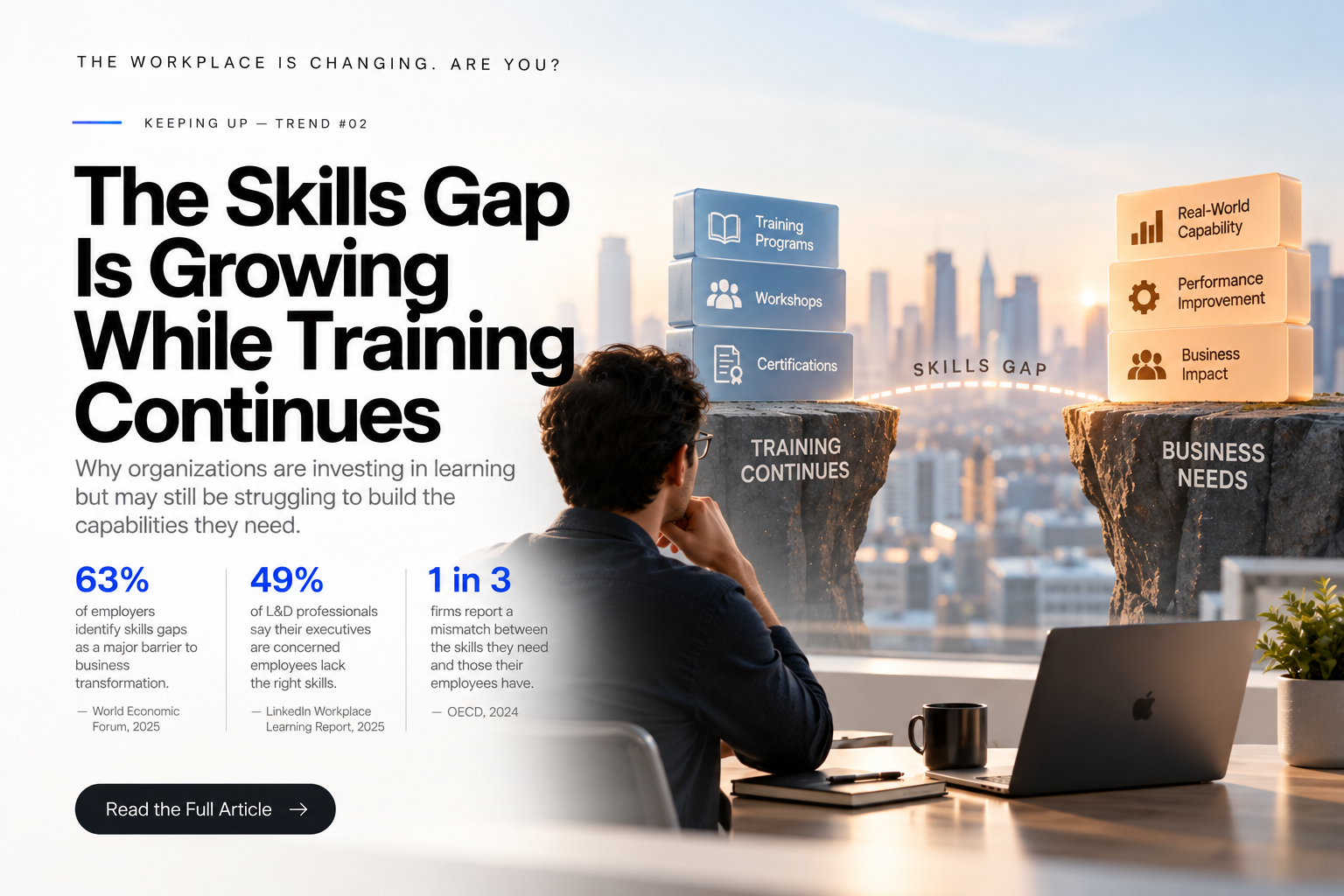
A company can deliver hundreds of training sessions, distribute certificates, and report excellent attendance figures and still struggle to find people with the skills its business requires.
The training calendar is full. The learning dashboard looks impressive. Yet performance gaps remain.
This is the paradox of modern corporate learning: training is happening, but are the right capabilities being built?
The uncomfortable numbers behind the skills gap.
The problem is not simply that employees need more training. Research suggests that organizations are struggling to align workforce capabilities with changing business demands.
According to the World Economic Forum’s Future of Jobs Report 2025, 63% of surveyed employers identify skills gaps as a major barrier to business transformation. Meanwhile, 85% expect to prioritize workforce upskilling between 2025 and 2030.
That is a significant commitment to learning. But it also reveals the scale of the challenge.
The OECD’s 2024 report, Understanding Skill Gaps in Firms, examined employer data from five European countries. Its findings are equally revealing:
- More than one in three firms reported a mismatch between the skills they needed and those their employees possessed.
- 63% of firms reporting skill gaps said these gaps increased the workload of existing staff.
- 50% reported increased operating costs.
- 46% experienced difficulties implementing new working practices.
- One in three said skill gaps limited their ability to adopt new technologies.
Source: OECD, Understanding Skill Gaps in Firms (2024).
The message is clear: skills gaps are not merely an HR concern. They can affect costs, workloads, operational efficiency and the ability to change.
Yet there is another finding worth considering. The OECD found that nine out of ten firms experiencing skill gaps used training and development to address them.
Training is already the most common response. So why do capability gaps remain such a persistent problem?
The problem may not be a lack of training.
Consider a sales team struggling to convert leads into customers. The organization responds with a sales training programme. Employees learn questioning techniques, objection handling and negotiation. Feedback is positive.
Three months later, conversion rates have barely changed.
What happened?
Perhaps employees need more practice. Perhaps managers are not coaching them. Perhaps the sales process is inefficient. Perhaps the leads are poorly qualified. Or perhaps the incentive system rewards the wrong behaviours.
The organization may have a training problem. But it may also have a process, leadership, resource or performance-management problem.
When every performance problem becomes a training programme, organizations risk treating symptoms instead of causes.
This is where many learning initiatives lose their impact.
Training can develop knowledge and skills. It cannot, by itself, fix every obstacle that prevents people from performing well.
The hidden gap between learning and capability -
There are three different things organizations often confuse:
-
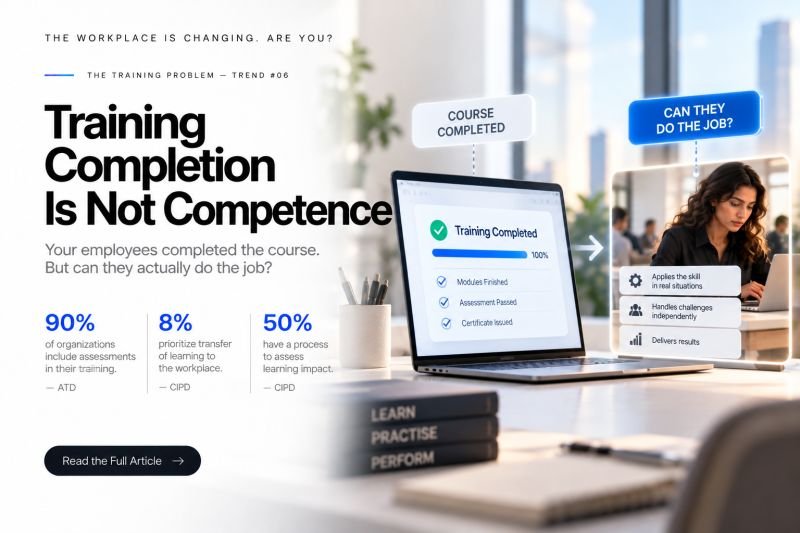
Learning activity Employees attend programmes, complete modules, participate in workshops and pass assessments.
-
Workplace capability Employees can demonstrate the required knowledge, skills and behaviours in realistic work situations.
-
Business performance The improved capability contributes to meaningful outcomes, such as fewer errors, faster processes, better customer experiences or higher sales conversion.
These three levels are connected, but one does not automatically guarantee the next.
An employee may understand a new customer-handling technique but return to a workplace where managers continue to reward speed over resolution.
A manager may learn coaching skills but have no time allocated for coaching conversations.
A team may complete AI training but lack clear guidance on when AI should be used, how its outputs should be checked, and who remains accountable for decisions.
In each case, the learning may be useful. The conditions required to apply it are missing.
The real challenge is not simply transferring knowledge. It is turning knowledge into consistent performance.
A new approach: From training delivery to capability building
LinkedIn’s Workplace Learning Report 2025 found that 49% of surveyed learning and talent development professionals said their executives were concerned that employees lacked the skills needed to execute business strategy.
The report also emphasizes the role of career development, coaching and internal mobility alongside learning in helping organizations respond to changing skill needs.
This points towards a broader approach.
Instead of beginning with the question, “What training should we deliver?”, organizations need to ask, “What must our people be able to do—and what is preventing them from doing it?”
That shift changes the entire learning process.
- Start with the business challenge. Identify the outcome that needs to improve.
- Diagnose the real gap. Determine whether the cause is knowledge, skill, motivation, management, process, tools or resources.
- Design the right intervention. Use training where it is needed, supported by practice, coaching, feedback and workplace changes.
- Enable application. Give employees the time, tools and opportunity to use what they have learned.
- Measure the difference. Examine changes in behaviour and relevant performance indicators—not just attendance and satisfaction.
- Adapt continuously. Reassess capability needs as technology, customer expectations and business priorities evolve.
This is not an argument against training. It is an argument for making training more purposeful.
What this means for trainers, managers and leaders
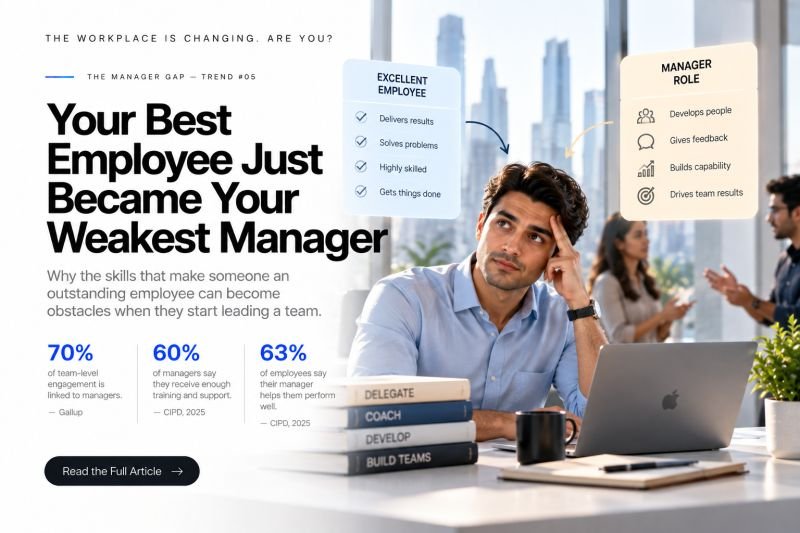
For trainers: Your responsibility begins before the workshop. Challenge unclear briefs, investigate performance gaps and define what successful application should look like.
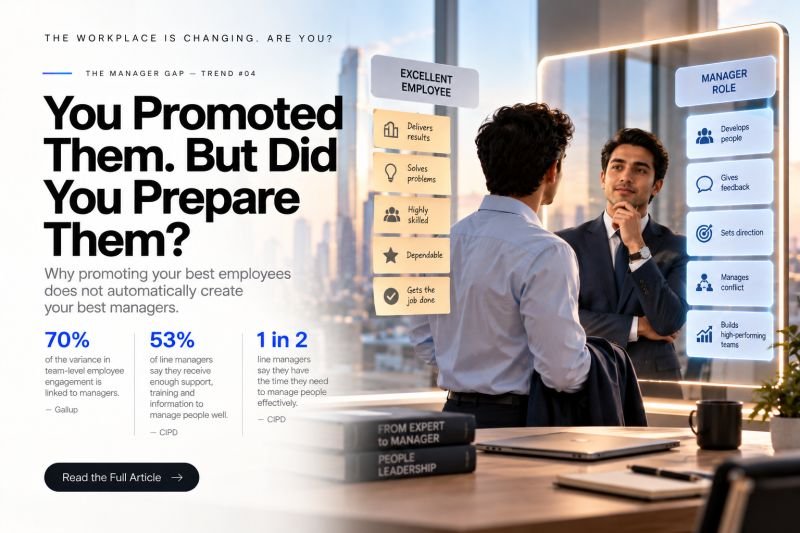
For managers: Learning needs reinforcement. Give employees opportunities to practise, observe their performance and provide feedback. What you encourage after training can matter as much as what they learn during it.
For leaders: Connect workforce capability to business strategy. Identify critical skills, anticipate future needs and ensure that processes, technology and management practices support performance.
The OECD research also highlights the importance of looking beyond training alone. Firms use recruitment and changes to work practices as additional responses to skill gaps. Different problems require different solutions.
Sometimes the answer is a course. Sometimes it is coaching. Sometimes it is a better process—or a decision to redesign the work itself.
The future belongs to organizations that learn to diagnose
As AI, automation and changing business models reshape work, capability requirements will continue to evolve.
Organizations that respond only after a performance problem becomes visible may find themselves constantly catching up.
Those that systematically identify emerging skill needs, assess existing capabilities and support workplace application will be better positioned to adapt.
The competitive advantage will not necessarily belong to the organization delivering the most training.
It will belong to the organization that can identify the right capability gap, close it effectively and demonstrate what changed.
Today: Organizations measure training through programmes delivered, participation, completion and feedback.
Tomorrow: They will need to connect those measures more directly to capability, workplace application and business outcomes.
THE QUESTION -
If your organization delivered every training programme on its calendar this year, but its most important performance problems remained unsolved, would you call it a successful learning year?
Or would you ask a more important question?
Are we closing the skills gap, or simply getting better at delivering training while the gap continues to grow?