Let's start with an uncomfortable thought.
You spent years becoming good at your job.
You attended courses.
You collected certifications.
You built experience.
You became the person people came to when something went wrong.
Congratulations.
You may now have a problem.
The world of work didn't promise to stay still while you became an expert.
And that's the part we don't talk about enough.
A skill that made you valuable five years ago may not make you equally valuable five years from now.
Not because you suddenly became bad at your job.
Because the job itself is changing.
The 39% problem
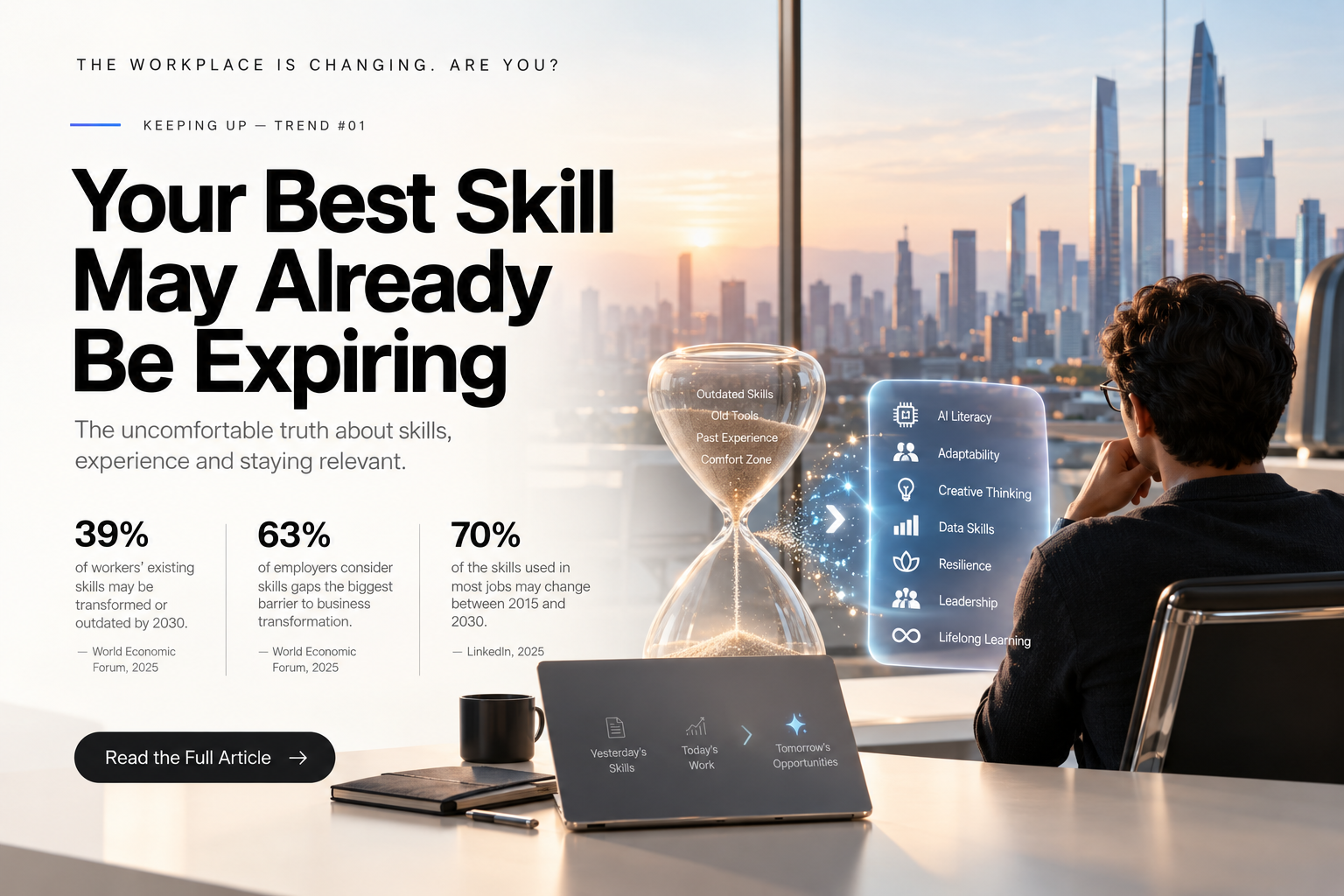
The World Economic Forum's Future of Jobs Report 2025 estimates that 39% of workers' existing skill sets will be transformed or become outdated between 2025 and 2030.
Read that again.
Not 3%.
Not 9%.
39%.
And skills gaps are already being felt today.
WEF found that 63% of employers consider skills gaps the biggest barrier to business transformation for 2025–2030. That puts skills gaps ahead of several other major transformation challenges.
So when an organization says:
"We need to transform."
The next question shouldn't simply be:
"Which technology should we buy?"
It should also be:
"Do our people have the skills to make the transformation work?"
Here's where it gets interesting.
The obvious response is:
"Fine. Let's train everyone."
Sounds sensible.
But there's a catch.
Training people for today's skills doesn't necessarily prepare them for tomorrow's work.
Imagine updating your phone once every five years.
Technically, it's still a phone.
But good luck convincing yourself it's "future-ready."
Organizations can make the same mistake with people.
They update the training catalogue.
They run the workshops.
They issue certificates.
They tick the completion box.
And then wonder why the capability gap is still there.
The problem isn't only skill shortage.
It's skill direction.
This is a subtle but important difference.
The question isn't only:
"What skills are we missing?"
It is:
"Which skills are becoming more valuable—and which ones are becoming less valuable?"
WEF's research shows that AI and big data, networks and cybersecurity, and technological literacy are among the fastest-growing skills.
But the story isn't simply "technology wins."
Analytical thinking, creative thinking, resilience, flexibility and agility, curiosity and lifelong learning, leadership and social influence also remain highly important.
In other words:
Tomorrow's employee needs both.
Technology capability and human capability.
AI literacy and judgment.
Technical competence and adaptability.
And here's the part trainers should pay attention to.
WEF estimates that, by 2030, out of every 100 workers:
- 29 are expected to need upskilling in their current roles.
- 19 may need reskilling and redeployment into different roles.
- 11 may need training but may not have access to it.
- Only 41 are expected not to require significant training.
So the future of training isn't:
"Let's organize some programmes."
It's increasingly:
"Let's understand where capability is going."
That is a very different job.
The L&D problem
This is where things get uncomfortable for training professionals.
If the business changes every year but the training needs analysis happens once a year...
something is wrong with the system.
If new technology changes the work but the competency framework doesn't change...
something is wrong with the system.
If employees attend training but their roles continue evolving...
something is wrong with the system.
And if your training catalogue contains 400 courses but nobody knows which skills the business will actually need two years from now...
Well...
you don't have a learning strategy.
You have a very impressive menu.
LinkedIn sees the same signal
LinkedIn's 2025 Workplace Learning Report found that 49% of L&D professionals say their executives are concerned that employees don't have the right skills to execute business strategy.
It also found that 91% of L&D professionals agree continuous learning is more important than ever for career success.
And LinkedIn's skills data suggests that roughly 70% of the skills used in most jobs may change between 2015 and 2030, with AI acting as an important catalyst.
So we're moving away from:
Learn → Qualify → Finish
toward:
Learn → Apply → Adapt → Relearn → Repeat
That's a completely different learning model.
What does this mean for Trainers?
Your job is changing.
The future trainer won't simply ask:
"What training programme should I deliver?"
They'll increasingly ask:
"What capability will this organization need next?"
That means becoming better at:
- skills-gap analysis
- workforce trends
- performance consulting
- business understanding
- learning analytics
- AI-enabled learning
- transfer of learning
- capability mapping
The trainer who understands the business problem will increasingly outperform the trainer who simply delivers a beautiful workshop.
Because PowerPoint has never had a shortage of competitors.
What does this mean for Managers?
Managers have a different responsibility.
You cannot expect employees to remain relevant while giving them no time, direction or opportunity to learn.
If your team's skills are becoming outdated, that's not just an HR problem.
It is a management problem.
Start asking:
What skills will my team need 12–24 months from now?
Who is already developing them?
Who is falling behind?
Which tasks could technology change?
Which human capabilities will become more valuable?
And perhaps the most uncomfortable one:
Am I developing people for the jobs they have—or the work they are likely to do?
What does this mean for Leaders?
The leadership question is even bigger.
You don't just need a workforce that can perform.
You need a workforce that can adapt.
WEF identifies resilience, flexibility and agility, analytical thinking, creative thinking and curiosity/lifelong learning among the important skills for the future.
And CIPD's 2026 research makes a related point around AI: the challenge isn't simply acquiring brand-new HR skills; organizations are struggling to apply existing capabilities such as workforce planning, job design and employee engagement to changing work.
So leadership development cannot remain:
"How to become a better leader."
It increasingly needs to become:
"How to lead people through changing work."
The new question for L&D
Perhaps we need to stop asking:
"What training do people need?"
And start asking:
"What will people need to be capable of?"
Those sound similar.
They aren't.
The first creates courses.
The second creates capability.
What should organizations do now?
- Stop treating skills as annual data.
Skills are moving too quickly.
Review critical skills continuously.
- Map skills to business strategy.
Don't start with:
"What courses should we buy?"
Start with:
"Where is the business going?"
Then work backwards.
- Identify declining skills as well as emerging skills.
Everyone loves a list of "top future skills."
Very few organizations ask:
Which existing skills are becoming less valuable?
That's equally important.
- Give managers a role in skill development.
Learning cannot live entirely inside the L&D department.
Managers see changing work first.
- Make learning part of work.
Don't wait for employees to leave their jobs to become future-ready.
Build learning into the job.
- Teach people how to learn.
Because the most future-proof skill may be:
the ability to acquire the next skill.
The uncomfortable conclusion
Your best employee may still be excellent.
Your most experienced manager may still be valuable.
Your most successful trainer may still be very good.
But none of them are automatically future-ready.
Experience gives you an advantage.
It doesn't give you immunity from change.
And perhaps that's the biggest mindset shift we need in corporate learning:
The goal of training isn't to make people good at today's work.
The goal is to help people remain capable as the work changes.
TODAY → TOMORROW
TODAY
Organizations are trying to close existing skill gaps.
TOMORROW
Organizations will increasingly need to anticipate skill gaps before they become performance problems.
IF WE DON'T ADAPT
Training becomes reactive.
Managers become overwhelmed.
Employees become less relevant.
And organizations discover the skills gap only after the business starts paying for it.
The question for Trainers, Managers & Leaders
If 39% of workers' existing skills could be transformed or outdated by 2030...
Which 39% are you preparing to replace?
And perhaps more importantly:
Which 61% are you preparing to strengthen?
Research used
- World Economic Forum, Future of Jobs Report 2025 — skills disruption, future skills, skills gaps and workforce strategies.
- LinkedIn Learning, Workplace Learning Report 2025 — skills crisis, continuous learning, career development and AI upskilling.
- CIPD, How AI is changing the application of HR skills, 2026 — workforce planning, job design, skills development and AI-driven workforce change.
- ATD, 2026 State of the Industry — learning hours, spending and talent-development priorities.
The key editorial lesson from Article #01
I would keep this style for the whole series:
Simple language.
Short paragraphs.
One or two numbers that make you stop.
A little humour.
No academic jargon unless we explain it.
Research first. Interpretation second.
Practical advice at the end.
And most importantly:
Don't tell the reader that the future is changing.
Show them how today's ordinary problem could become tomorrow's expensive problem.
That is what will make "The Workplace Is Changing. Are You?" feel different from ordinary corporate trend content.