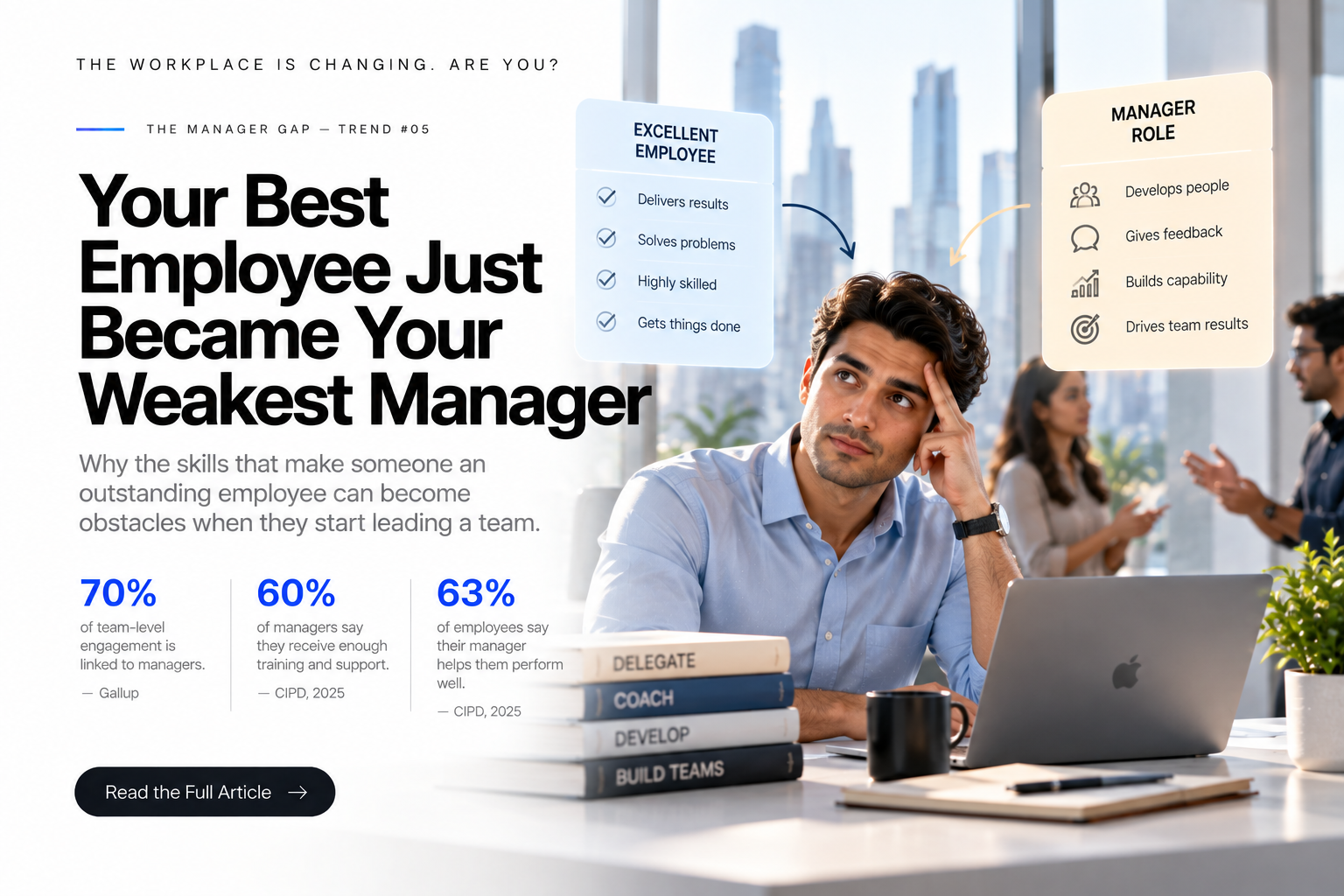
Your star employee gets promoted.
They know the work better than anyone. They solve problems quickly. They rarely miss deadlines. When something goes wrong, they step in and fix it.
Everyone expects them to become a great manager.
Six months later, their team cannot make decisions without them. Employees wait for instructions. Delegation has become difficult. The manager works longer hours than ever, while the team struggles to become independent.
What went wrong?
Perhaps the employee did not lose their talent. Perhaps they are still using the very habits that made them successful—in a role that now demands something different.
The best employee gets results by doing excellent work. The best manager builds a team that can deliver excellent work.
Those are two different jobs. Yet organizations often expect people to move from one to the other without changing how they work.
THE RESEARCH: The manager gap is bigger than a promotion decision
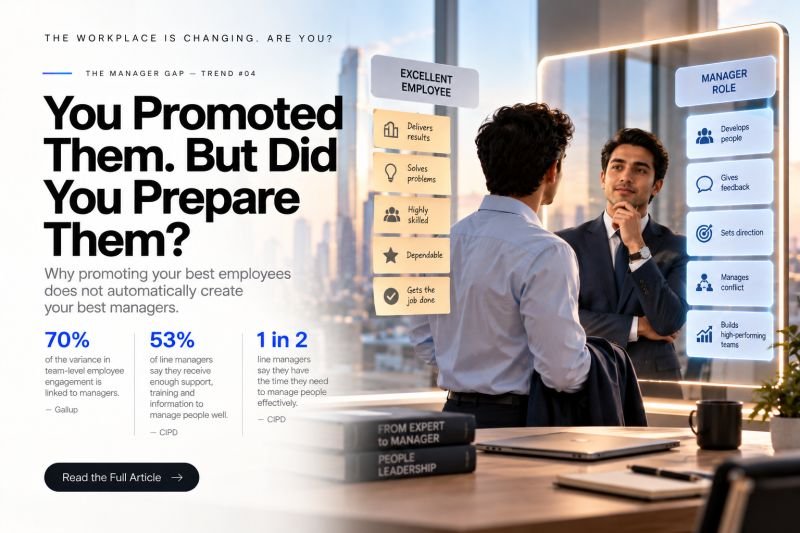
Gallup's research offers a striking insight: managers account for at least 70% of the variance in team-level employee engagement. This does not mean managers alone determine engagement. It highlights how strongly the manager influences differences in employees' workplace experiences.
Now consider whether organizations are adequately preparing people for this responsibility.
The CIPD Good Work Index 2025, based on UK employee and manager surveys, found that:
-
Only 60% of managers said they received the training and information needed to manage people well.
-
Only 59% said they had enough time to manage their staff effectively.
-
Among employees with a line manager, just 63% said their manager helped them perform well in their job.
These figures reveal an important tension.
Organizations place managers at the centre of employee performance, development and engagement. Yet a substantial proportion of managers report lacking the preparation or time they need.
The issue is not simply whether someone deserves a promotion.
It is whether organizations redesign the person's work and develop the capabilities required by the new role.
WHY HIGH PERFORMERS SOMETIMES STRUGGLE AS MANAGERS
Three habits that help employees succeed can become management obstacles.
1. They solve instead of develop
A high-performing employee is often rewarded for solving problems quickly.
When a team member struggles, the new manager may instinctively step in, provide the answer and move on.
It feels efficient.
But repeated over time, this creates dependency. Employees stop developing their own judgement because the manager keeps doing the thinking for them.
The management shift is from being the best problem-solver to building better problem-solvers.
2. They do instead of delegate
The employee knows exactly how the work should be done. Explaining it to someone else seems slower than doing it personally.
So they take over.
Soon, the manager becomes the team's busiest employee. Team members wait for approvals, routine decisions get escalated and strategic work gets pushed aside.
Delegation is not merely assigning tasks. It is transferring responsibility while providing the clarity and support needed for success.
3. They focus on output instead of people
Individual contributors are often measured by their own results. Managers must also consider how people collaborate, develop and sustain performance.
That requires conversations many new managers have never practised: giving difficult feedback, resolving conflict, addressing underperformance and helping employees navigate uncertainty.
Technical expertise may establish credibility. It does not automatically create these interpersonal skills.
THE SHIFT: Redefine what success looks like
The new manager needs a different performance equation.
| Individual contributor | People manager |
|---|---|
| Completes the work | Enables the team to complete the work |
| Solves problems | Builds problem-solving capability |
| Protects personal productivity | Balances team priorities and development |
| Demonstrates expertise | Uses expertise to coach others |
| Owns individual results | Takes responsibility for collective performance |
This does not mean managers should stop being technically competent. Their expertise remains valuable.
The change is in how that expertise is used.
Instead of answering every question, they ask better questions. Instead of taking over every difficult task, they coach employees through it. Instead of measuring success only by what they personally deliver, they build a team capable of delivering consistently.
A manager's greatest contribution may be the capability they create in other people.
THE MOVE: Develop managers before they become overwhelmed
Organizations do not need to wait until a new manager struggles before providing support.
A practical approach has five parts:
-
Assess more than individual performance. Look for communication, judgement, collaboration, accountability and an interest in developing others.
-
Create opportunities to practise leadership. Let aspiring managers lead projects, mentor colleagues and facilitate team discussions before promotion.
-
Teach essential management skills. Focus on delegation, coaching, feedback, conflict resolution and performance conversations.
-
Support the first 90 days. Provide a mentor, regular check-ins and opportunities to discuss real management challenges.
-
Measure team outcomes. Examine employee development, clarity, collaboration and performance—not just whether the manager completed a training programme.
CIPD research also emphasizes that effective people management is associated with employee wellbeing, performance and commitment. Its findings reinforce the importance of developing managers and giving them the support to apply what they learn.
And there is one more issue leaders must address: workload.
You cannot expect someone to coach, delegate and develop a team if their calendar is still designed around doing all the work themselves.
Manager development requires both new skills and room to use them.
TODAY → TOMORROW
TODAY: Organizations often reward strong individual performance with a promotion into management.
TOMORROW: Organizations will need to distinguish technical excellence from management readiness—and prepare employees for the transition before the promotion becomes a performance problem.
Not every excellent employee needs to become a manager, either. Some people can grow through specialist or technical career paths without taking responsibility for a team.
Promotion should be a move into the right role, not simply the next rung on the ladder.
THE QUESTION
Your best employee has just become a manager.
They still work late. They still solve everyone's problems. They still deliver impressive individual results.
But their team is becoming increasingly dependent on them.
Have they become a better manager—or simply an excellent employee with more responsibilities?
Research sources
-
Gallup — Manager Development: What It Is, Why It Matters and How It Works.
-
CIPD — Investment in Line Managers, Employee Wellbeing and AI.
-
CIPD — Managers Need Better Training and Support to Nurture Productive Teams.
By ICARIANS — The House of Corporate Learning The Workplace Is Changing. Are You? Research-backed signals for Trainers, Managers and Leaders.