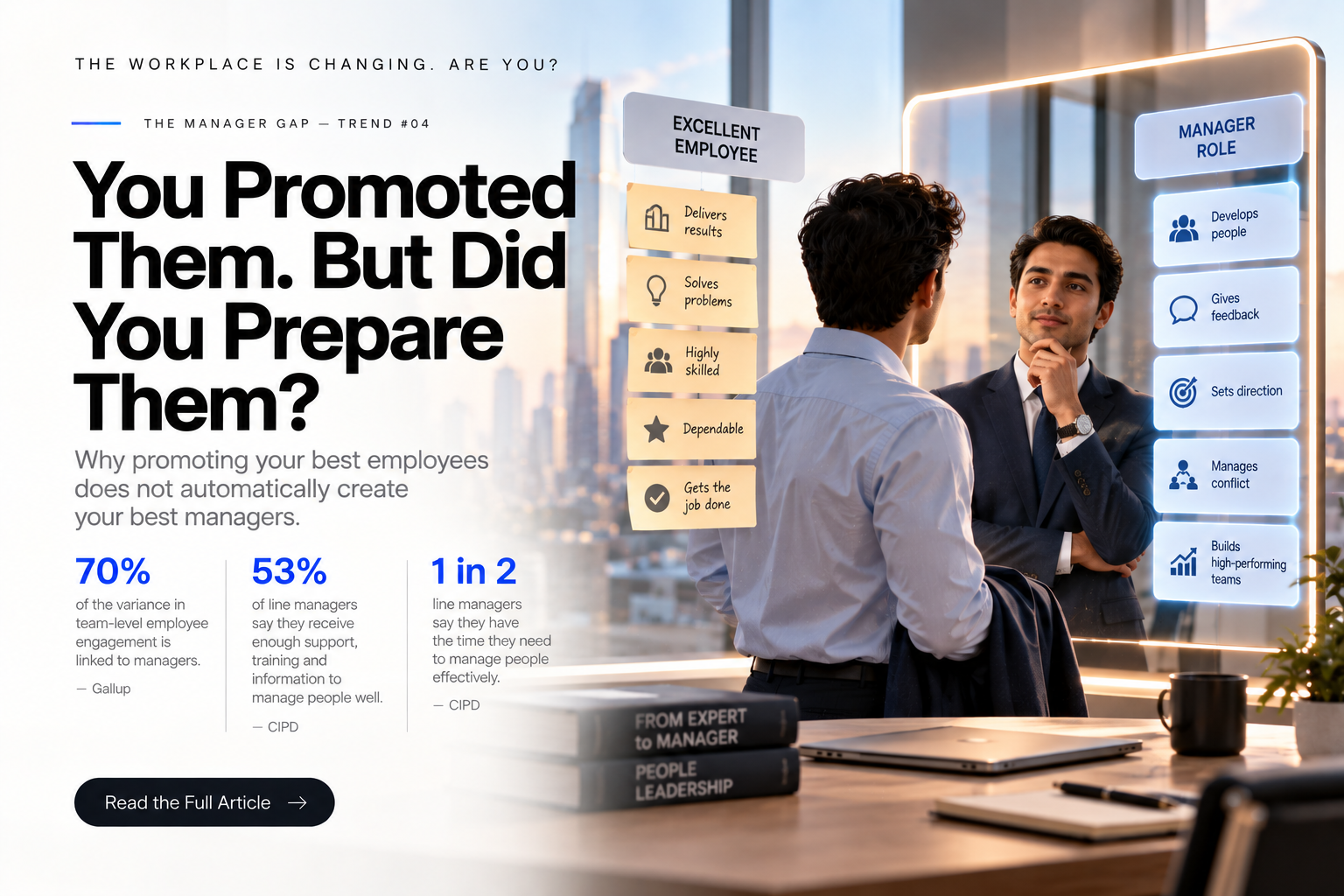
Why promoting your best employees does not automatically create your best managers.
Your best salesperson consistently exceeds targets. Your most capable engineer solves problems nobody else can. Your most dependable employee always gets the job done.
So, when a managerial position opens up, the decision seems obvious.
Promote them. There is just one problem.
Being excellent at doing the work is not the same as being excellent at leading the people who do it.
The salesperson who once managed customers must now coach a team of salespeople. The engineer who solved technical problems must now resolve conflicts, delegate work and develop people. The dependable employee must now hold others accountable—even when those conversations are uncomfortable.
Yesterday, success depended largely on personal performance. Today, success depends increasingly on the performance of others.
Yet many organizations promote people into management and expect them to figure out the rest.
That is one of the most expensive assumptions in workplace development.
THE RESEARCH: Your manager affects more than you think
Research suggests that the consequences of getting this promotion wrong extend far beyond the individual.
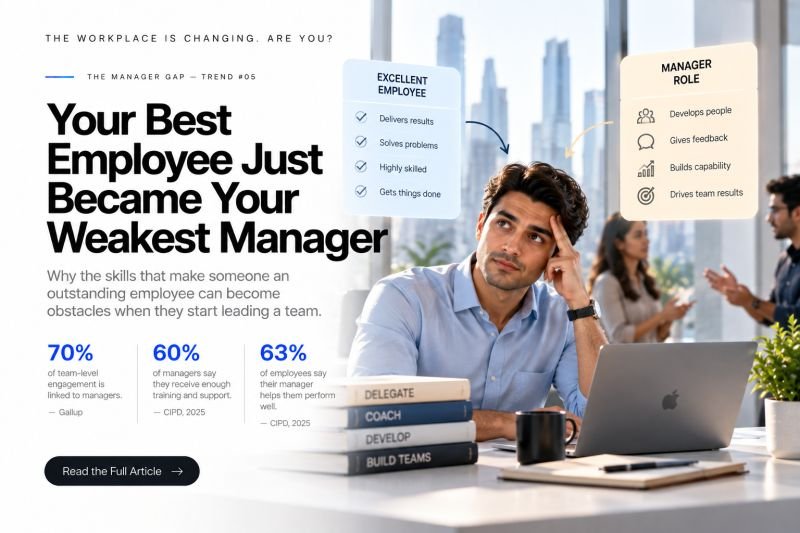
According to Gallup, managers account for at least 70% of the variance in team-level employee engagement. This is Gallup's estimate of the influence managers have on differences in engagement between teams—not a claim that managers alone determine 70% of engagement.
Why does this matter?
Managers shape the everyday experience of work: how clearly expectations are communicated, how fairly people are treated, whether feedback is useful, and whether employees feel supported in their development.
The CIPD's UK Working Lives research offers another revealing finding:
53% of line managers surveyed said they received enough support, training and information to manage people well.
Only half agreed that they had the time they needed to manage people effectively.
Employees with top-quartile line managers were more likely to volunteer for responsibilities beyond their formal job descriptions.
In other words, organizations expect managers to develop people while many managers themselves may lack sufficient time or support.
That is a capability gap hiding in plain sight.
THE REAL PROBLEM: Organizations promote performance, not management readiness
Most employees are promoted for understandable reasons.
They deliver results. They know the business. They are reliable. They have earned trust.
But these qualities do not automatically demonstrate an ability to manage people.
An excellent individual contributor often succeeds by being personally effective. They solve problems, make decisions, and deliver work themselves.
A manager must learn a different discipline: getting results through other people.
That requires skills many employees have had little opportunity to practise before promotion:
- Delegating without micromanaging.
- Coaching instead of immediately providing the answer.
- Giving difficult feedback without damaging trust.
- Resolving conflict between team members.
- Setting priorities when everything appears urgent.
- Managing performance fairly and consistently.
- Developing people who may have different strengths, motivations and needs.
The transition also involves an emotional adjustment.
Yesterday, the employee competed with their own performance standards. Today, they may be responsible for evaluating former peers.
Yesterday, solving the problem personally demonstrated competence. Today, solving every problem personally may prevent the team from developing.
The new manager must stop being the person who always has the answer and become the person who helps the team find better answers.
That is not a small change in responsibilities. It is a change in how success is defined.
THE HIDDEN COST: Your best employee may become an overloaded manager
Consider what happens when a high-performing engineer becomes a team manager.
The engineer is still expected to deliver technical work. Now they must also conduct performance reviews, resolve disagreements, plan workloads, coach junior employees and attend management meetings.
What gets sacrificed? Often, the new manager's development—and sometimes the team's development.
The manager continues doing the work they already know how to do because it feels productive and familiar. Delegation feels risky. Coaching feels slower than giving instructions. Difficult conversations get postponed.
The team becomes dependent on the manager. The manager becomes overwhelmed. And senior leaders wonder why the team is not becoming more independent.
This is how organizations accidentally create high-performing employees who struggle to build high-performing teams.
It is not always a talent problem. Sometimes, it is a preparation problem.
THE SHIFT: Prepare people before the promotion
A common approach is to promote an employee first and enrol them in management training later.
But the transition often begins before the formal promotion. Employees may already be leading projects, mentoring colleagues or making decisions that affect others.
This creates an opportunity.
Organizations can identify aspiring managers early and give them realistic opportunities to practise management responsibilities before making the appointment.
For example:
-
Test the interest. Does the employee actually want to manage people, or are they pursuing the only visible route to career progression?
-
Assess readiness. Look for listening, judgement, accountability, collaboration and the ability to develop others—not just individual results.
-
Create practice opportunities. Let aspiring managers lead projects, facilitate team discussions, mentor colleagues and handle supervised feedback conversations.
-
Teach the fundamentals. Develop skills in delegation, coaching, communication, performance management and conflict resolution.
-
Support the transition. Pair newly promoted managers with experienced mentors and provide regular feedback during their first months.
-
Measure effectiveness. Evaluate whether managers clarify expectations, develop employees, improve team performance and handle people challenges effectively.
This is not about delaying every promotion until someone completes a long course.
It is about treating management as a distinct profession that requires preparation, practice and continuous development.
WHAT THIS MEANS FOR TRAINERS, MANAGERS AND LEADERS
For Trainers and L&D professionals: Stop treating new-manager training as a one-off event. Build a development pathway that starts before promotion and continues through the transition. Include simulations, coaching practice, workplace assignments and manager feedback.
For current managers: Recognize that your job is not to become indispensable. It is to build a team that can perform well without depending on you for every decision.
For HR and business leaders: Revisit your promotion criteria. Ask whether you reward only individual achievement or also recognize the ability to develop people. Create career paths that allow employees to advance without assuming everyone must become a people manager.
As the CIPD's research emphasizes, organizations must think carefully about how they recruit and develop managers so they are equipped to manage people effectively.
TODAY → TOMORROW
TODAY: Employees are often promoted because they excel at their current jobs. Management training may follow after they have already taken on the role.
TOMORROW: Organizations that deliberately prepare future managers can make the transition less disruptive, strengthen team capability and reduce the risk of leaving new managers to learn everything through trial and error.
The aim is not to eliminate every management mistake. Managers will still learn through experience.
The aim is to stop treating avoidable mistakes as the price of promotion.
THE QUESTION
Your best employee may be ready for a bigger responsibility.
But have you assessed their readiness to lead people—or simply rewarded their ability to deliver results?
When you promote someone into management, are you promoting a proven manager—or asking a proven employee to become one without preparation?