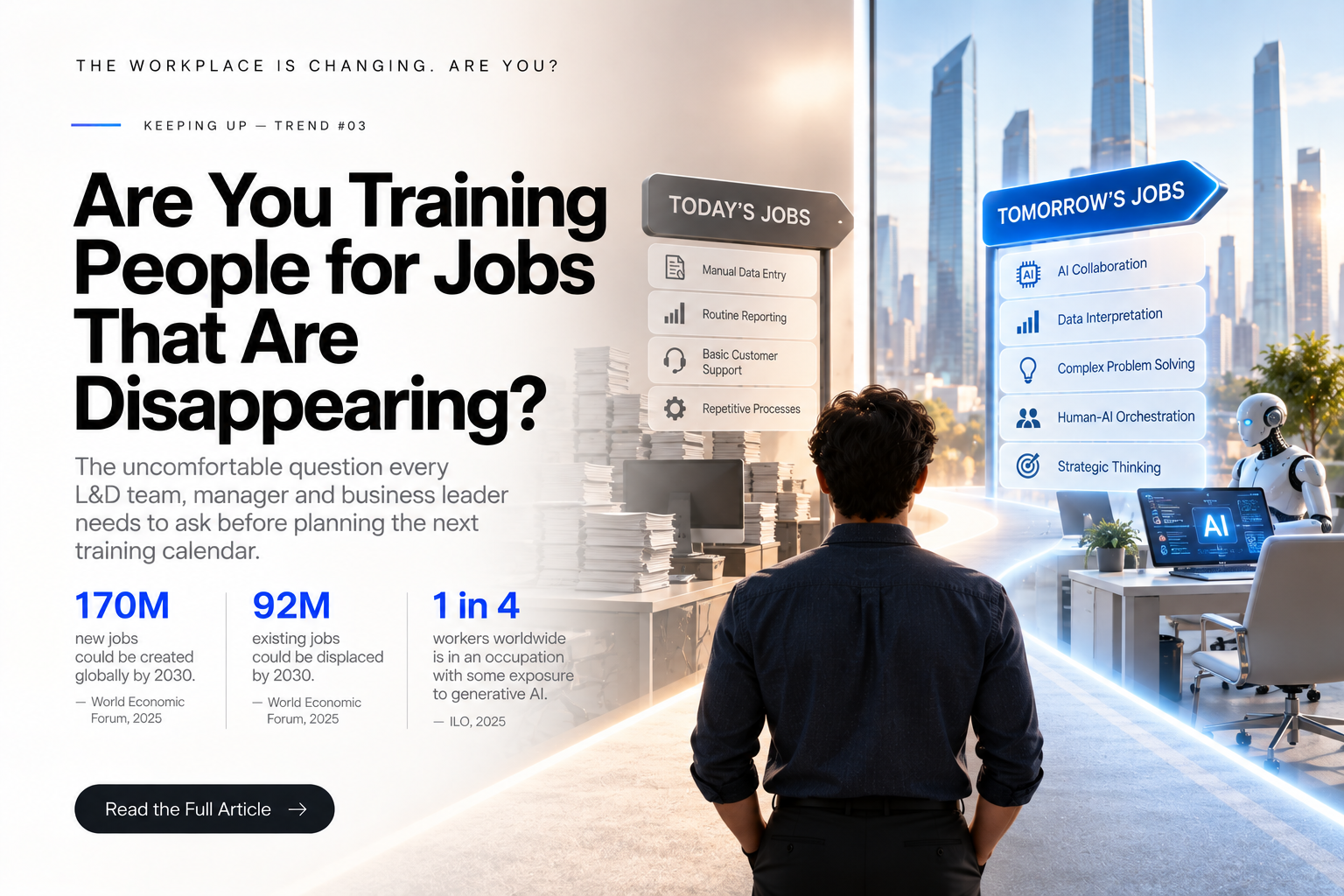
The uncomfortable question every L&D team, manager and business leader needs to ask before planning the next training calendar.
Imagine spending six months training employees to perform a task more efficiently.
Then the company automates that task.
The training was delivered. The employees learned the process. The certificates were issued.
But the work they were trained to do is becoming less necessary.
Was the training a waste?
Not necessarily. The real question is whether the organization prepared those employees for what comes next.
The biggest workforce challenge may not be teaching people to do today's jobs better. It may be preparing them to do tomorrow's work differently.
And that changes how we should think about corporate training.
THE SIGNAL: The jobs of tomorrow are already taking shape
The World Economic Forum's Future of Jobs Report 2025 estimates that, by 2030, structural changes in the labour market could create 170 million jobs and displace 92 million existing jobs globally.
That represents a projected net increase of 78 million jobs. But the headline hides a more important challenge: millions of workers may need to transition into different roles or learn to perform their current jobs differently. These are employer expectations and projections, not guaranteed outcomes.
The International Labour Organization (ILO) adds another important perspective.
Its 2025 research estimates that one in four workers worldwide is in an occupation with some exposure to generative AI. However, the ILO concludes that job transformation is more likely than complete job replacement for most occupations.
This distinction matters.
The future is not simply a story of jobs disappearing. It is also a story of tasks changing, responsibilities shifting and new capabilities becoming essential.
A finance professional may spend less time preparing routine reports and more time interpreting business risks.
A customer service executive may use AI to draft responses but need stronger judgement to handle complex complaints.
A manager may automate routine reporting but become more responsible for coaching, decision-making and managing human-AI workflows.
The job title may survive. The skills required to perform the job may not remain the same.
THE SHIFT: Train for the work ahead, not just the work that exists
Many organizations design training around current job descriptions, existing competency frameworks and last year's performance gaps.
That is understandable. These are familiar, measurable and easy to convert into training plans.
But they can also create a dangerous blind spot.
If a job is changing, training employees to perform its current tasks more efficiently may not prepare them for its future responsibilities.
Consider three examples:
-
Data entry to data validation: As routine processing becomes automated, employees may need stronger skills in exception handling, data quality and problem-solving.
-
Report preparation to business interpretation: When software produces reports faster, the ability to question assumptions, identify patterns and explain implications becomes more valuable.
-
Task supervision to workflow orchestration: As teams use AI and automation, managers may need to coordinate people, technology, decisions and accountability.
The OECD's research on automation and skills similarly emphasizes that technology changes the tasks people perform and the skills those tasks require. It can replace some activities while complementing others.
The lesson for L&D is straightforward:
Do not ask only, “What does this employee need to learn to perform today's job?” Ask, “How is this job likely to change, and what capabilities will the employee need next?”
THE FUTURE RISK: Yesterday's training can become tomorrow's skills gap
Imagine an organization that spends heavily on training employees to use a particular system.
The system is later replaced by an AI-enabled platform.
The original training may have been entirely appropriate when delivered. Yet the organization now faces a new capability gap.
This is not necessarily a training failure. It may be a failure to anticipate how the work would evolve.
Three risks deserve attention:
-
Training for declining tasks. Employees become more efficient at activities that are gradually being automated or reduced.
-
Ignoring transferable skills. Employees learn a specific tool but not the problem-solving, communication or judgement needed to adapt when the tool changes.
-
Waiting too long to reskill. Organizations begin capability development only after a role has changed, leaving employees and managers struggling to catch up.
The danger is not that every employee needs to learn AI immediately or that every traditional skill is becoming obsolete.
The danger is treating today's job design as permanent.
WHAT SHOULD TRAINERS, MANAGERS AND LEADERS DO?
For Trainers: Review your programmes against emerging work requirements. Ask whether the learning develops transferable capabilities or merely teaches a current procedure. Include realistic scenarios that require judgement, adaptation and problem-solving.
For Managers: Identify which tasks in your team are changing. Discuss how responsibilities may evolve and give employees opportunities to practise new tasks before they become essential.
For Leaders and L&D Heads: Build future capability planning into workforce strategy. Work with business leaders to identify roles likely to change, critical skills that may emerge, and employees who could transition into new responsibilities.
THE MOVE: Run a Future-Ready Training Test
Before approving your next major training programme, ask five questions:
-
Relevance: Will this skill remain useful over the next two to three years?
-
Automation: Which parts of this job could technology perform, support or change?
-
Transferability: Will employees learn principles they can apply beyond one tool or process?
-
Transition: If this role changes, what adjacent roles or responsibilities could employees move into?
-
Evidence: What signals will tell us that the capability remains relevant—or needs updating?
You do not need perfect predictions. You need a process for reviewing assumptions and adapting before the gap becomes costly.
TODAY → TOMORROW
TODAY: Training often begins with current job requirements and known performance gaps.
TOMORROW: Effective workforce development will increasingly need to combine current performance improvement with anticipation of changing roles, tasks and capabilities.
The goal is not to predict every job that may disappear.
It is to prepare people to remain useful, adaptable and capable as their work changes.
THE QUESTION
If your organization is training employees to become better at their current jobs, who is preparing them for the jobs those roles may become?
Are you building tomorrow's capabilities or making people more efficient at yesterday's work?