
Imagine an organization investing in a communication programme.
Employees learn to listen actively, ask better questions and give constructive feedback.
The workshop ends. Everyone returns to work.
On Tuesday, an employee tries to raise a concern.
The manager interrupts, “Just do what I said.”
On Wednesday, another employee offers a suggestion, “That's not how we do things here.”
By Friday, the team has learned something far more powerful than anything in the training room.
Keep your ideas to yourself. Nothing is going to change.
The organization spent money teaching employees to communicate. Nobody prepared the manager to listen.
And then, six months later, leadership wonders why the training had limited impact.
Welcome to a familiar corporate contradiction: organizations train employees to change their behaviour without preparing the people who control the environment in which that behaviour must change.
THE RESEARCH: Managers need training, time and support
The Chartered Institute of Personnel and Development's Good Work Index 2025 offers an important signal.
Among managers surveyed in the UK:
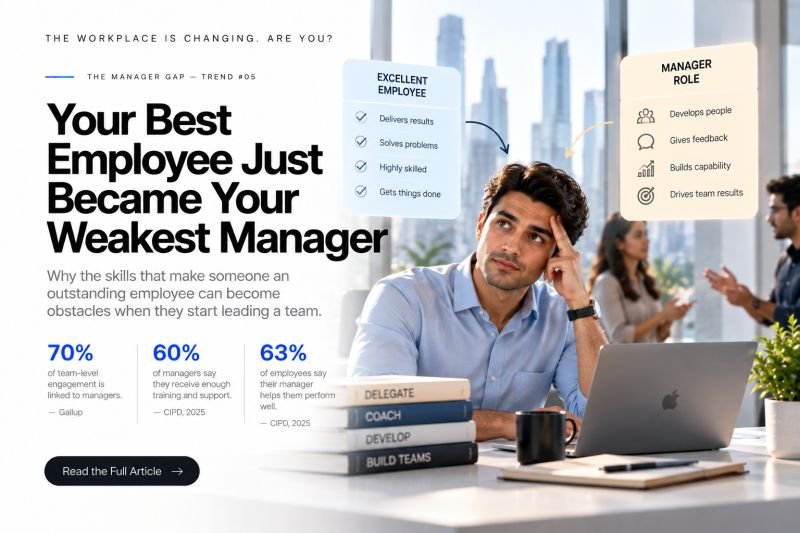
- 60% said they received the training and information needed to manage their staff well.
- 59% said they had enough time to manage their staff well.
Both figures improved from 52% in 2023. That is encouraging progress, but it also means that around four in ten managers did not report having the training and information, or the time, they needed. "Read the CIPD report" (https://www.cipd.org/globalassets/media/knowledge/knowledge-hub/reports/2025-pdfs/2025-good-work-index-8868.pdf).
The same report found that 63% of employees with a line manager said their manager helped them perform well, while 62% said their manager provided useful feedback.
These findings do not prove that inadequate manager training caused every workplace problem. They do show that management capability and support remain relevant areas for improvement.
The CIPD's 2025 analysis of the line manager's role in learning also highlights a practical challenge: L&D may control the formal learning experience, but managers often influence whether employees can apply and develop their skills afterwards. "Read the analysis" (https://www.cipd.org/en/views-and-insights/thought-leadership/insight/learning-value-role-manager/).
Training does not happen in isolation. It happens inside a management system.
If that system contradicts the lesson, the employee receives two competing instructions.
One comes from the trainer.
The other comes from the person who evaluates their performance, assigns their work and decides what gets rewarded.
Guess which instruction is likely to win?
THE FIVE MANAGEMENT CONTRADICTIONS THAT UNDERMINE TRAINING
1. You train people to take ownership. Their manager refuses to delegate.
The training programme encourages initiative, accountability and independent decision-making.
Back at work, every decision requires approval.
Employees are told to think like owners but are managed like temporary visitors.
The result: People may understand ownership without having the authority to practise it.
What needs to change: Define decision-making boundaries, delegate meaningful responsibilities and help managers coach rather than control every detail.
2. You train people to innovate. Their manager punishes mistakes.
The organization announces that innovation is a strategic priority.
Employees attend creativity workshops and learn techniques for generating new ideas.
Then somebody tries something different, makes a reasonable mistake and gets publicly blamed.
The message is clear: innovate, but only if nothing can go wrong.
The result: Employees learn to protect themselves instead of experimenting responsibly.
What needs to change: Train managers to distinguish careless mistakes from reasonable experiments, provide constructive feedback and create appropriate room for learning.
3. You train managers to coach. Their calendars leave no time for people.
Managers attend coaching workshops. They practise asking questions, listening and helping employees find solutions.
Then they return to back-to-back meetings, urgent reports, approval queues and unrealistic workloads.
Coaching becomes something they intend to do when work becomes less busy.
In many organizations, that magical day never arrives.
The result: Coaching remains a classroom concept rather than a management habit.
What needs to change: Protect time for people management, simplify low-value administrative work and make coaching part of normal operating routines.
4. You train teams to collaborate. Their targets reward individual competition.
Employees learn cross-functional problem-solving and shared accountability.
But performance reviews reward only individual numbers. Departments compete for resources. Information becomes a source of power.
The workshop promotes collaboration. The performance system promotes self-protection.
The result: Employees may collaborate during the exercise and compete again when the incentives return.
What needs to change: Align goals, recognition and performance measures with the collaboration the organization actually wants.
5. You train people to communicate openly. Their manager only wants good news.
The organization encourages employees to raise risks early, challenge assumptions and speak honestly.
But managers react defensively to bad news and treat disagreement as disloyalty.
Employees quickly learn to soften the message, delay the conversation or say nothing.
The result: Communication training improves vocabulary without necessarily improving candour.
What needs to change: Help managers listen without immediate defensiveness, ask follow-up questions and respond constructively to concerns.
In every example, the employee may have learned the right skill.
The organization has simply made the skill difficult to use.
THE SHIFT: Stop treating managers as spectators in employee development
Managers are often invited to nominate participants, approve training budgets and receive completion reports.
But they may not be involved in identifying the workplace behaviour that needs to change, preparing employees to apply learning or reinforcing that behaviour afterwards.
That is a missed opportunity.
A manager does not need to become a professional trainer. But they do need to understand their role in making learning useful.
Consider a sales training programme.
A more complete approach involves three connected stages.
Before training: The manager identifies a specific performance gap with the employee, agrees on a target and discusses opportunities to practise.
During training: The trainer develops the relevant skills using realistic scenarios and explains how they connect to the employee's work.
After training: The manager observes the employee applying the skill, provides feedback, removes practical barriers and reviews progress.
Now the trainer and manager are supporting the same outcome.
The manager is no longer waiting for L&D to deliver a miracle in two days.
They are helping employees turn learning into performance.
THE MOVE: Introduce a simple manager reinforcement contract
Before your next leadership, sales, communication or management programme, agree on five responsibilities.
-
The business problem What performance issue should the programme help address?
-
The target behaviour What should participants do differently when they return to work?
-
The opportunity to practise Where and when will employees use the skill in a real work situation?
-
The manager's role What will the manager observe, discuss, encourage or change to support application?
-
The review date When will the employee and manager review progress, discuss barriers and agree on next steps?
Keep the agreement practical. One or two observable behaviours are often more useful than a long list of vague development commitments.
For example, after a delegation programme, a manager might agree to delegate one appropriate task each week, clarify the expected outcome and review progress without taking the task back at the first sign of difficulty.
That creates a repeatable opportunity to practise.
It also creates evidence that can inform coaching and further development.
The manager reinforcement contract is a practical recommendation, not a standardized research instrument. Adapt it to the role, the programme and the level of support employees need.
WHAT THIS MEANS FOR TRAINERS AND L&D LEADERS
For corporate trainers: Ask about the participant's working environment before designing the intervention. Find out what managers expect, what they reward and what opportunities employees will have to practise.
For L&D teams: Include manager briefings, workplace assignments and follow-up conversations in programme design. Do not assume that sending a completion email is the same as securing management support.
For managers: Your role is not finished when your employee returns from training. Help them apply the learning, provide useful feedback and examine whether your own practices support the change.
For senior leaders: Do not demand new behaviours from employees while leaving the systems, incentives and management habits that discourage those behaviours untouched.
Quality corporate training materials, leadership training materials, management training materials and ready-made training materials can help trainers deliver consistent learning experiences. A well-designed training facilitator guide can also make manager involvement and workplace application easier to build into a programme.
But no collection of slides can compensate for a manager who actively blocks the behaviour those slides promote.
If employees are expected to change, managers must be part of the change.
TODAY → TOMORROW
TODAY: Managers may be treated as approvers of training, with limited involvement in what happens before and after the programme.
TOMORROW: Managers will be treated as active partners in capability development, with clear responsibilities for practice, feedback, reinforcement and the removal of workplace barriers.
This does not mean blaming managers for every unsuccessful training intervention. Managers face their own workload pressures, conflicting priorities and capability gaps.
It means giving them the preparation, time and authority to support the outcomes the organization expects.
Training effectiveness is not solely the responsibility of the trainer.
It is a shared responsibility across the learning team, the manager, the employee and the wider organization.
THE QUESTION
Your employees attend a two-day programme on leadership, communication or accountability.
They return to work ready to behave differently.
But their manager continues to reward the old behaviour, discourage new ideas and prioritize the same routines.
Who failed to learn the lesson: the employee, the trainer or the organization that expected change without changing how it manages people?
Research sources
- Chartered Institute of Personnel and Development (CIPD), 2025. Good Work Index 2025. Survey findings on manager support, training and time to manage people. "Research report" (https://www.cipd.org/globalassets/media/knowledge/knowledge-hub/reports/2025-pdfs/2025-good-work-index-8868.pdf).
- CIPD, 13 March 2025. How L&D can create value: Role of the line manager in supporting skills development. "Research analysis" (https://www.cipd.org/en/views-and-insights/thought-leadership/insight/learning-value-role-manager/).
- CIPD, 9 June 2025. Good Work Index 2025 report makes case for investment in line managers, employee wellbeing and AI. "Research summary" (https://www.cipd.org/uk/about/news/good-work-index-2025-investment-line-managers-employee-wellbeing-ai/). . . ICARIANS — The House of Corporate Learning