
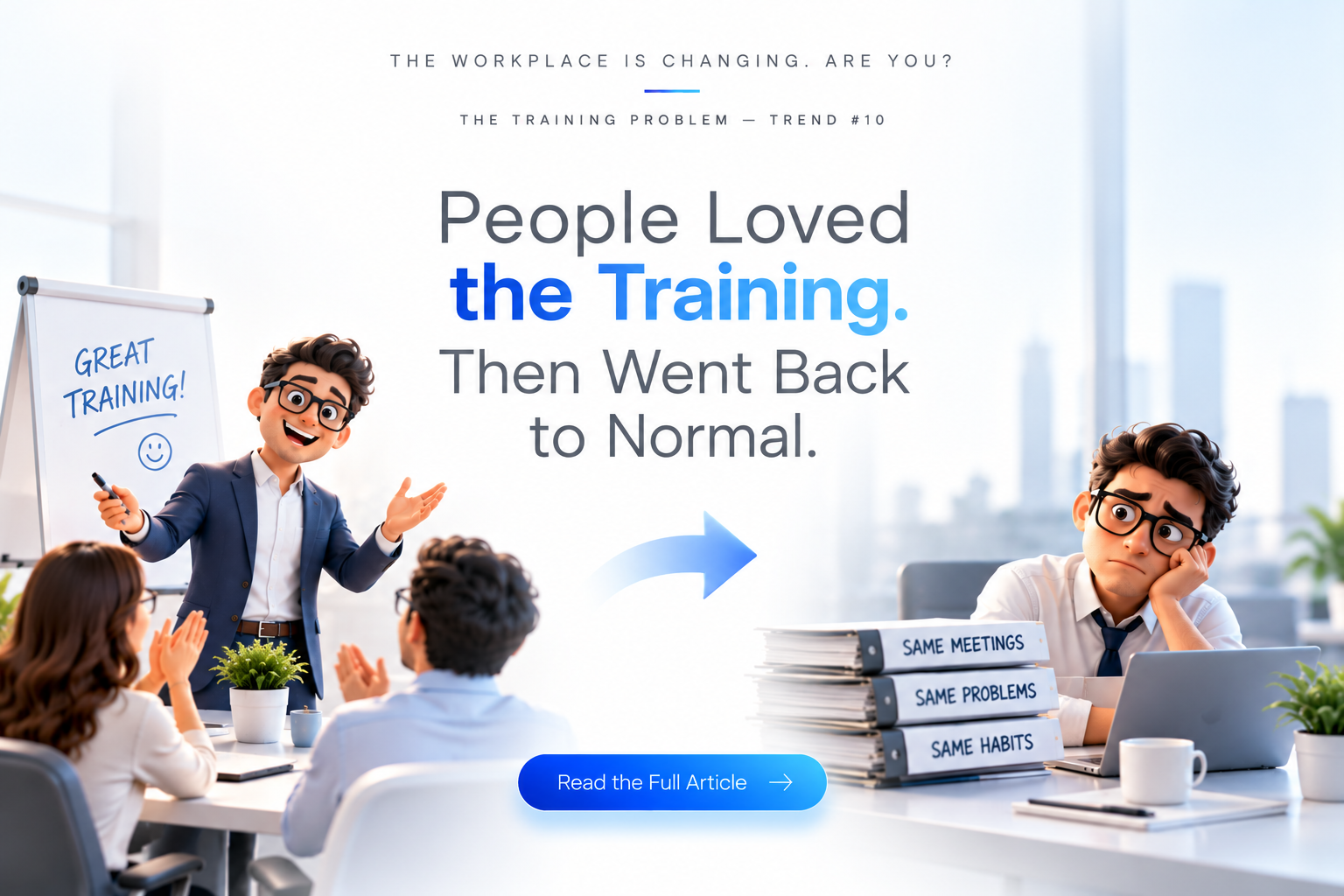
The workshop was excellent. The feedback forms were glowing. The business results?
Apparently, they missed the invitation.
The trainer was brilliant. At the end, the feedback scores were outstanding. “Very informative.” “Excellent session.” “Learned a lot.” “Would recommend.”
Everyone was happy. Then Monday arrived.
The manager returned to micromanaging. The salesperson returned to pitching without listening. The team returned to the same meetings, the same mistakes and the same old habits.
The training was over. The workplace had barely noticed.
Welcome to one of corporate learning's most uncomfortable realities: employees can enjoy a training programme without changing how they work.
And organizations can mistake a successful event for a successful intervention.
THE RESEARCH: Learning transfer is where the real challenge begins
The Chartered Institute of Personnel and Development (CIPD), in its Learning at Work 2023 research, found that only 8% of surveyed L&D professionals strongly prioritized transferring learning into the workplace.
The same survey of 1,108 professionals responsible for supporting workplace learning, conducted predominantly in the UK, found that only 50% reported having a process for assessing learning impact. Just 36% said line managers supported their teams in transferring learning back into the workplace. "Read the CIPD report" (https://www.cipd.org/en/knowledge/reports/learning-at-work/).
Think about that. Organizations spend time identifying training needs, selecting providers, preparing corporate training materials, booking venues and releasing employees from their daily responsibilities.
Yet the process for ensuring people actually use what they learned can receive far less attention.
It is like buying an expensive gym membership, attending the opening ceremony and expecting improved fitness.
The membership is real. The transformation is still pending.
These figures are from 2023, so they should not be treated as a measurement of every organization today. But they highlight a persistent question for the L&D profession:
Are we designing learning experiences, or are we designing changes in workplace performance?
Those are not always the same thing.
THE CORPORATE ILLUSION: Five things we confuse with learning success
1. High satisfaction means high impact
Participants enjoyed the session. That is good. But enjoyment is not proof of competence, and satisfaction is not proof of business impact.
A participant can give a trainer five stars and still struggle to apply the skill two days later.
Feedback forms tell you how participants experienced the programme. They do not, on their own, tell you whether workplace performance improved.
The uncomfortable question: What can participants do now that they could not do before?
2. A correct answer means a changed behaviour
An employee can explain the principles of effective delegation in a classroom.
That does not guarantee they will delegate effectively when a deadline is approaching and the temptation to do everything themselves becomes irresistible.
Knowing the right answer and performing the right behaviour under pressure are different capabilities.
Learning design must therefore include practice, feedback, realistic scenarios and opportunities to demonstrate competence.
3. The trainer is responsible for everything
The trainer delivers a workshop on coaching.
Participants return to managers who never make time for coaching, criticize every mistake and demand immediate results.
What happens next? Employees quickly discover which behaviour the organization actually rewards.
The lesson from the workshop competes with the lesson from the workplace. The workplace usually has more opportunities to reinforce its message.
Research published in Business Horizons in 2024 examined the role of manager support in connecting workplace learning with performance.
It highlighted practical assistance, guidance and emotional support as important dimensions of how managers support learning. "Read the research" (https://www.sciencedirect.com/science/article/abs/pii/S0007681323001222).
Trainers are responsible for designing effective learning. Organizations and managers are responsible for creating conditions in which that learning can be applied.
You cannot train someone to behave differently and then reward them for behaving exactly as before.
4. One workshop can solve a long-standing habit
A two-day leadership programme cannot automatically undo years of micromanagement. A communication workshop cannot instantly repair a culture of blame.
A time-management session cannot eliminate a workload that exceeds the available working hours.
Training can initiate change. Sustained change often requires practice, feedback, reinforcement and adjustments to the working environment.
The workshop is an intervention, not a magic spell. Even the best facilitator guide cannot make organizational barriers disappear.
5. Completion means the job is done
The LMS says 100% completed. The attendance sheet is signed. The certificates have been issued. The dashboard is green.
Meanwhile, the original performance problem is still sitting at its desk.
Completion confirms that an activity took place. It does not confirm that employees mastered the skill, applied it at work or improved a business outcome.
A completed programme is an output. Improved performance is a potential outcome. Do not report one as the other.
THE SHIFT: Design for Monday morning, not just the training room
If learning is supposed to change workplace performance, then the design process must extend beyond the workshop.
Consider a leadership programme focused on delegation.
A conventional approach might include presentations, group discussions, case studies and an end-of-programme assessment.
A transfer-focused approach asks a different question:
What will each manager do differently when they return to work?
That question changes the entire design. Before the programme, participants identify a real task they should delegate.
During the programme, they practise clarifying expectations, choosing the right person, agreeing boundaries and establishing follow-up.
After the programme, they delegate the task, discuss the outcome with their manager and reflect on what worked.
The manager observes the behaviour and provides feedback.
The L&D team checks whether the target behaviour improved and, where appropriate, whether relevant performance indicators changed.
Now the programme has a route from learning to application.
It still cannot guarantee results. Business conditions, resources and other factors matter. But it creates a much stronger opportunity for learning to influence performance.
THE MOVE: Build a 30-day learning transfer plan
You do not necessarily need another platform, another application or another expensive learning technology.
Start with a simple plan.
Before training: Establish the starting point.
- Identify the specific behaviour or skill that needs improvement.
- Agree on what successful performance looks like.
- Ask the participant's manager to identify a real opportunity to apply the learning.
During training: Practise the actual work.
- Use realistic business scenarios.
- Give participants opportunities to practise and receive feedback.
- Ask each participant to select one or two behaviours to apply immediately.
Within the first seven days: Apply the learning.
- Complete a workplace practice task.
- Ask the manager or a peer to observe the relevant behaviour.
- Record what worked and what needs improvement.
By day 15: Reinforce and adjust.
- Discuss barriers to application.
- Provide coaching or additional practice.
- Modify processes or expectations if the workplace is preventing the desired behaviour.
By day 30: Review the evidence.
- Compare performance with the original baseline where data is available.
- Review observed behaviour and work outputs.
- Identify what improved, what did not and what needs further support.
Thirty days is a practical starting point, not a universal rule. Some skills require longer periods to develop, and some outcomes take months to appear.
The important principle is that follow-up should be designed into the programme rather than added later as an optional extra.
WHAT THIS MEANS FOR TRAINERS, MANAGERS AND L&D LEADERS
For corporate trainers: Stop treating the final slide as the finish line. Build workplace practice, follow-up activities and manager involvement into your programme design.
For managers: Ask employees how they will apply the learning. Give them opportunities to practise. Recognize improved behaviour instead of expecting immediate perfection.
For L&D leaders: Measure more than attendance, completion and satisfaction. Establish processes for observing skill application and assessing relevant business outcomes.
For organizations purchasing training: Do not evaluate a provider only by the quality of the presentation or the energy in the room. Ask how the programme supports application after delivery.
High-quality ready-made training materials, leadership training materials, management training materials and corporate training PowerPoint presentations can make learning more consistent and effective. A strong training facilitator guide can help trainers create meaningful practice and feedback.
But the resource is only one part of the system.
The real test is what happens when the participant returns to work.
TODAY → TOMORROW
TODAY: Training success is often celebrated when the programme ends. Participants complete the session, feedback is collected and the next programme enters the calendar.
TOMORROW: Effective L&D teams will design learning around the entire journey: preparation, practice, workplace application, reinforcement and measurement.
This is also where the training ROI conversation becomes more meaningful.
If you want to understand the return on training investment, begin by identifying what changed, how that change was measured and whether there is credible evidence connecting the intervention to the result.
Do not claim that training caused every improvement. Examine other contributing factors and the quality of the evidence.
The aim is not to make every workshop responsible for solving the entire business. It is to stop declaring victory before the real work has begun.
THE QUESTION
Your participants loved the training. Your managers praised the trainer. Your feedback scores are excellent.
But 30 days later, what is different at work? If the honest answer is “not much,” perhaps the next training programme does not need better slides.
Perhaps it needs a better plan for what happens after the last slide.
Research sources
- Chartered Institute of Personnel and Development (CIPD). Learning at Work 2023. "Research report" (https://www.cipd.org/en/knowledge/reports/learning-at-work/).
- Blume, B. D., Ford, J. K. and Huang, J. L. (2024). Transfer of informal learning: The role of manager support in linking learning to performance. Business Horizons, 67(2), 125–136. "Research article" (https://www.sciencedirect.com/science/article/abs/pii/S0007681323001222).
- Association for Talent Development. "Research and resources on learning, talent development and performance" (https://www.td.org/atd-research).
ICARIANS — The House of Corporate Learning