
Let's say, A department head approaches the L&D team with a familiar request. “Our managers need leadership training.”
Another department asks for communication skills. The sales team wants negotiation training. The HR team recommends an AI workshop.
The L&D team collects the requests, prepares a training needs analysis template, identifies the most common requirements and builds the annual training calendar.
Everything looks organised.
But there is one question nobody has asked:
What business problem are these training programmes supposed to solve?
Perhaps managers are struggling because they lack leadership skills. Or perhaps they have too many direct reports, unclear authority and little support from senior management.
Perhaps salespeople need negotiation training. Or perhaps they are losing deals because of poor lead quality, uncompetitive pricing or slow approvals.
The requested training may be appropriate. But without investigating the problem, nobody can be sure.
A training needs analysis is not successful because it produces a long list of training requirements. It is successful when it identifies the right capability gaps and helps determine the right response.
THE RESEARCH: The diagnosis matters more than the request
The Chartered Institute of Personnel and Development's Learning at Work 2023 report found that addressing skills gaps was the top priority for 29% of surveyed L&D professionals. The same research found that 57% said they proactively investigated performance issues before recommending a solution, compared with 32% in 2021.
The improvement is encouraging. But it also raises an important question: what happens when a learning intervention is recommended before the underlying problem is properly understood?
Research from the Organisation for Economic Co-operation and Development (OECD) provides another reason to take diagnosis seriously.
Its 2024 report, Understanding Skill Gaps in Firms, examined employer survey data from five European countries. More than one in three firms reported a mismatch between the skills they needed and those their employees possessed.
Among firms reporting skill gaps:
- 63% reported increased workloads for existing staff.
- 50% reported higher operating costs.
- 46% reported difficulties implementing new working practices.
- Around one-third said skill gaps limited their ability to adopt new technologies.
These findings show why capability gaps matter to business performance. They do not mean that every operational problem can be fixed through training.
In fact, the OECD highlights the importance of connecting skills assessment with targeted development and other organizational responses.
The first task is to identify the gap. The second is to understand what is causing it. Only then should training become the proposed solution.
THE HIDDEN PROBLEM: Training requests are not diagnoses
Consider three common workplace situations.
1. “Our employees need communication training.”
The actual problem: customer complaints are increasing because employees provide inconsistent information.
Possible causes include inadequate product knowledge, unclear procedures, outdated documentation or poor communication skills.
A communication workshop might help. But if employees are receiving contradictory instructions from different departments, training alone will not solve the problem.
2. “Our managers need leadership training.”
The actual problem: projects are repeatedly delayed because managers struggle to delegate.
Possible causes include weak delegation skills, unclear responsibilities, excessive workloads or a culture in which managers are penalised whenever team members make mistakes.
Leadership training may be necessary. Yet the organization may also need clearer accountability and better management practices.
3. “Our sales team needs negotiation training.”
The actual problem: conversion rates are declining.
Possible causes include poor prospect qualification, ineffective discovery conversations, pricing constraints, weak product positioning or genuine negotiation deficiencies.
Sending everyone to a negotiation workshop without investigating the causes may consume the budget while leaving the main problem untouched.
In all three situations, the training request describes a proposed solution—not necessarily the actual need.
THE SHIFT: From training needs to performance needs
A useful training needs analysis should examine three connected levels.
1. Organizational analysis What business outcomes need to improve? Examples include reducing errors, improving customer retention, increasing sales conversion, improving safety or preparing for a new technology.
2. Role and task analysis What must employees be able to do to support those outcomes?
This involves identifying the knowledge, skills, decisions and behaviours required in specific roles.
3. Individual analysis What can employees currently do, and where does their performance differ from the required standard?
Evidence may come from assessments, work samples, observation, performance data, manager discussions and employee feedback.
The purpose is to identify the specific gap between current and desired performance—not simply to ask employees which courses they would like to attend.
A strong analysis also considers whether the gap is caused by a lack of knowledge or skill, or by other barriers such as inadequate tools, unclear expectations, limited authority or insufficient time.
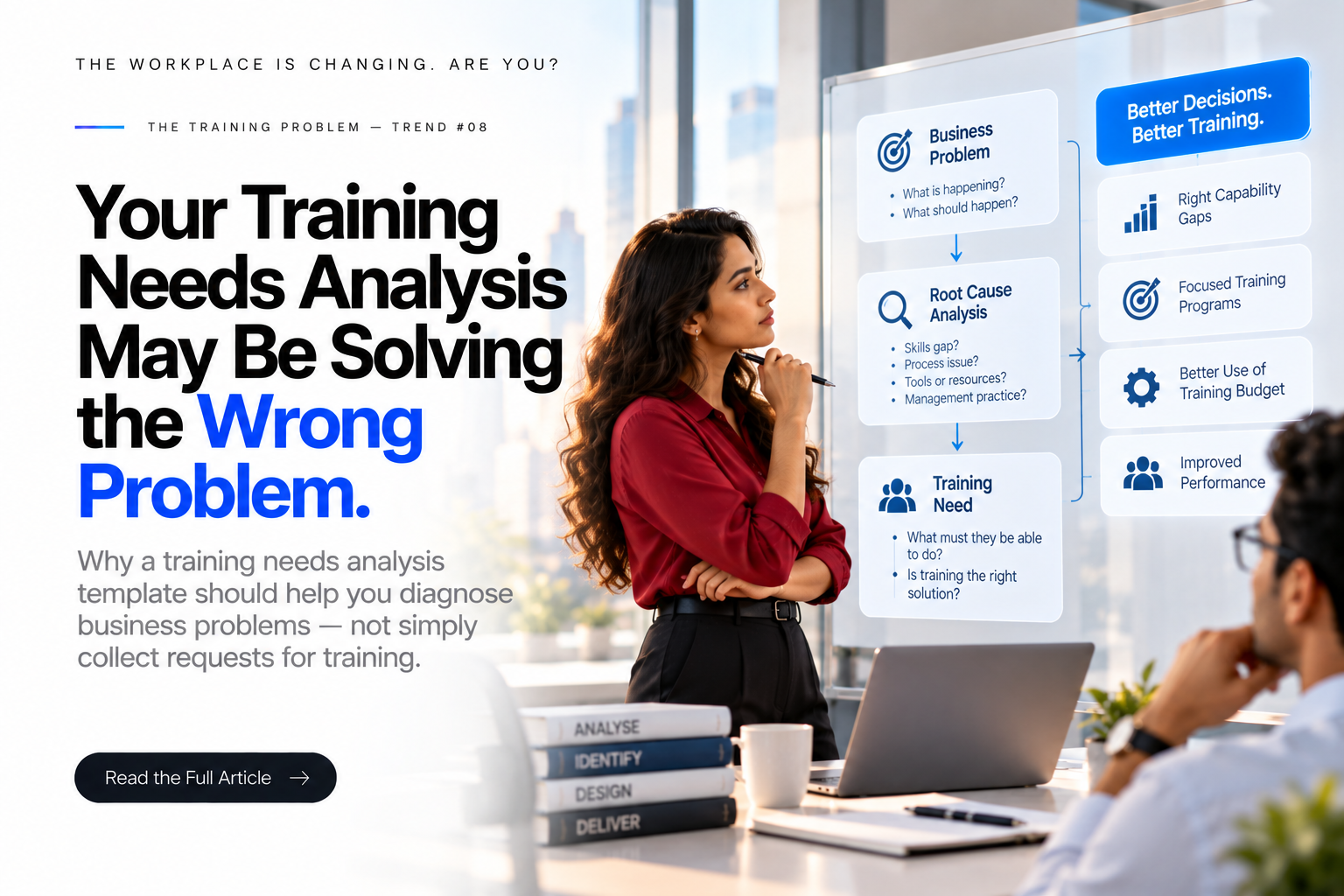
This is where a structured training needs analysis template becomes valuable. It gives L&D professionals a consistent way to document the business issue, investigate its causes, identify capability requirements and recommend an appropriate intervention.
The template is a tool. The quality of the diagnosis depends on the questions asked and the evidence gathered.
THE MOVE: Ask these five questions before recommending training
Before adding a programme to your training calendar, investigate:
- What is happening? Define the performance problem using specific examples or evidence.
- What should be happening? Establish the required standard or business outcome.
- Why is the gap occurring? Examine skills, knowledge, processes, resources, expectations and management practices.
- Would training address the cause? Determine whether employees need to learn something they currently cannot do.
- How will improvement be verified? Identify the behaviour, performance indicator or work outcome that should change.
The answers may lead to a training programme, coaching, process improvement, job aids, clearer procedures, better tools or a combination of solutions.
This is not about making the needs analysis unnecessarily complicated.
It is about avoiding expensive assumptions.
WHAT THIS MEANS FOR TRAINERS AND L&D TEAMS
For independent trainers, a well-diagnosed need helps you design relevant programmes instead of delivering generic content against an unclear brief.
For corporate L&D teams, it helps prioritise limited budgets and connect learning interventions with business objectives.
For organizations using ready-made training materials, it helps determine whether an existing programme is appropriate and what customization may be necessary.
Even the best corporate training PowerPoint presentations and training facilitator guides cannot compensate for a poorly understood business problem. Quality learning resources support delivery, but the intervention must address the right need in the first place.
Better training does not begin with better slides. It begins with a better diagnosis.
TODAY → TOMORROW
TODAY: Training calendars are often shaped by departmental requests, competency frameworks and identified skill gaps.
TOMORROW: Stronger L&D teams will connect business performance analysis, capability assessment and targeted interventions before deciding what training to deliver.
The goal is not to reduce the number of training programmes.
It is to ensure that every programme has a clear reason to exist.
THE QUESTION
When a manager requests leadership training, do you immediately begin searching for a programme—or investigate why the leadership problem exists?
Is your training needs analysis identifying the real capability gap, or simply organising the training requests your organization already knows how to make?
ICARIANS — The House of Corporate Learning